
Performance Appraisals: The Complete Guide to Planning, Tracking & Rewarding Performance
From goal setting to rewards — here’s how to run appraisals that actually drive results.

Hi HR Newbie,
Let’s be honest.
Most performance appraisals don’t fail because of the system.
They fail because no one takes them seriously until it’s too late.
Managers avoid difficult conversations all year.
Employees walk in unsure of where they stand.
HR ends up chasing forms instead of driving performance.
And then once a year, everyone sits down to “review performance.”
That’s not a performance system. That’s a formality.
But when done right, a performance appraisal is one of the most powerful tools in your HR toolkit.
It’s where clarity happens.
Where performance is aligned.
Where growth is documented — and direction is set.
Let’s break down how to actually get it right.
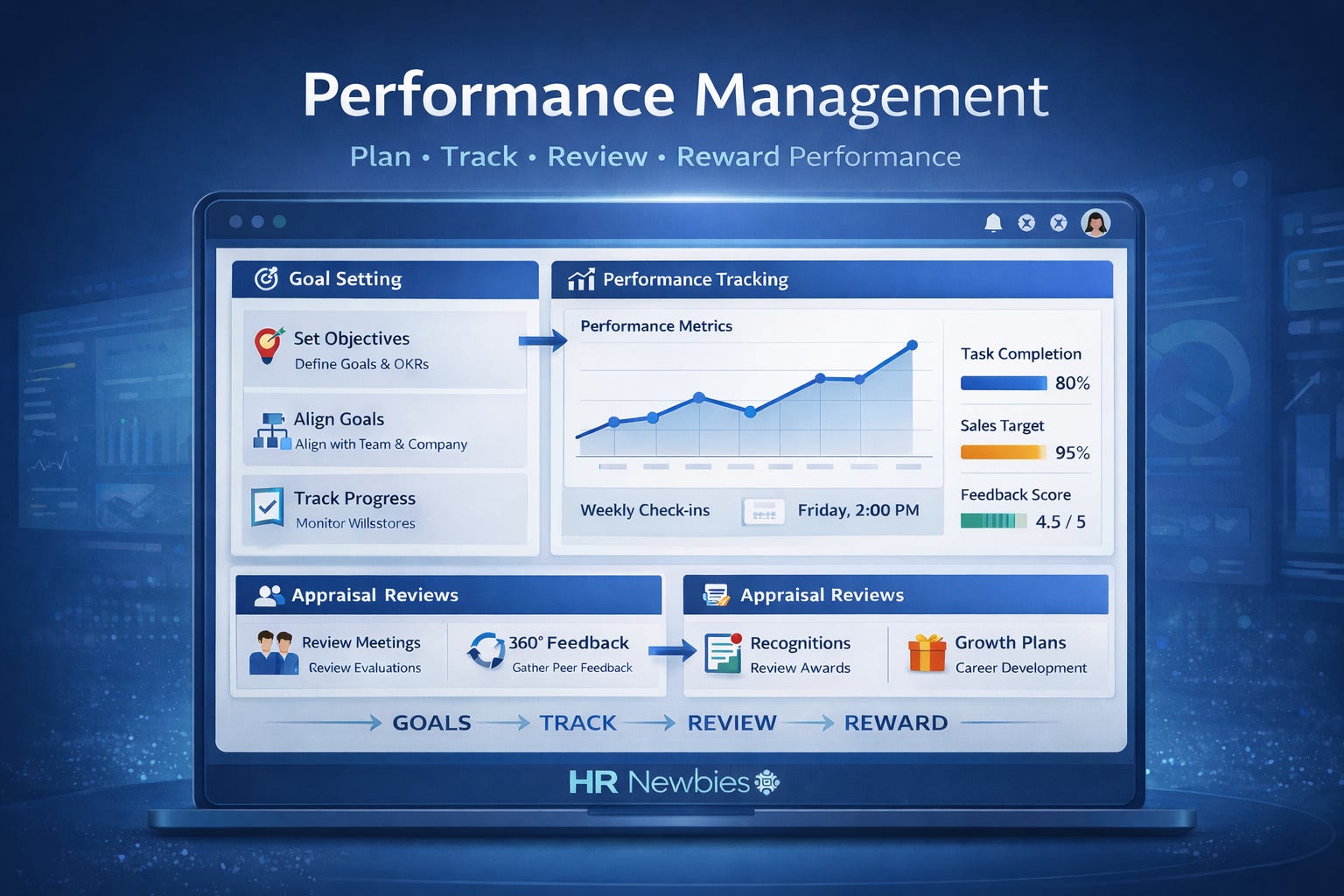
What Is a Performance Appraisal?
A performance appraisal is a structured process of evaluating an employee’s work over a specific period.
It looks at:
What they were expected to do
What they actually did
How they did it
Where they need to grow
But here’s the part many organisations miss:
A performance appraisal should never be the first time an employee hears feedback.
If it is, the system has already failed.
Why It Matters More Than You Think
For employees, a good appraisal answers the questions they’re often too unsure to ask:
Am I doing well?
Does my work actually matter here?
Is there a future for me in this organisation?
For managers and HR, it answers:
Who is ready for more responsibility?
Where are the gaps on this team?
Who might be disengaging — and why?
For the organisation, it creates:
→ A culture of accountability
→ A record of performance over time
→ A clear foundation for promotions, rewards, and succession planning
Skip the appraisal — and you don’t just skip a process.
You create confusion, disengagement, and a workforce that has no idea where they stand.
Part 1: Planning Goals Per Department
Before any appraisal can happen — goals must exist.
Not vague expectations. Not assumptions.
Clear, measurable goals that employees understand from day one.
Step 1 — Start With Organisational Goals
HR must work with leadership to understand the company’s priorities.
Department goals should always ladder up to business outcomes.
Step 2 — Collaborate With Department Heads
HR doesn’t set goals alone. This is a partnership.
Every goal should be:
→ Specific
→ Measurable
→ Achievable
→ Relevant
→ Time-bound
If a goal can’t be measured, it can’t be managed.
Step 3 — Cascade Goals to Individuals
Managers must translate department goals into individual KPIs.
Every employee should be able to answer:
“What exactly am I being measured on this quarter?”
If they can’t — that’s not an employee problem.
That’s a system gap HR needs to fix.
Step 4 — Document Everything
Goals that aren’t written down don’t exist.
Use a shared system or document that both manager and employee can access throughout the cycle.
Part 2: Tracking Appraisals to Ensure Timeliness
Setting goals is the easy part.
Making sure appraisals actually happen — consistently — is where most organisations fail.
1. Build an Appraisal Calendar
At the start of each cycle, define:
→ Goal-setting deadlines
→ Mid-year check-ins
→ Appraisal windows
→ Submission deadlines
→ Feedback communication dates
Clarity prevents delay.
2. Send Reminders — Don’t Assume
Managers are busy. Appraisals are rarely their top priority.
HR must drive the process with reminders:
4 weeks before
2 weeks before
1 week before
Launch day
If you don’t follow up, it won’t happen.
3. Track Completion Rates
HR should always know:
→ Who has submitted
→ Who hasn’t
→ What’s overdue
Don’t wait. Follow up directly.
HR doesn’t own performance — but HR owns the process.
4. Run Mid-Year Check-ins
Waiting until year-end is too late.
A simple 30-minute check-in mid-cycle allows:
Course correction
Feedback alignment
Reduced end-of-year tension
Part 3: What a Good Performance Appraisal Covers
A strong appraisal isn’t just a form — it’s a structured conversation across five areas:
1. Goal Achievement
Were targets met?
Were they realistic?
What got in the way?
2. Core Competencies
How did the employee show up beyond tasks?
Communication
Teamwork
Initiative
Problem-solving
3. Strengths & Wins
What worked well?
This matters more than most managers think.
If employees only hear what’s wrong, they disengage.
4. Areas for Improvement
Be specific. Be fair.
Focus on behaviour and impact — not personality.
5. Development Plan
What happens next?
Every appraisal should end with:
Clear actions
Growth opportunities
Defined next steps
An appraisal without a forward plan is incomplete.
Part 4: How to Run an Appraisal That Actually Works
Before the Appraisal
→ Share the form in advance
→ Have employees complete a self-appraisal
→ Review goals and past feedback
During the Appraisal
→ Start with wins
→ Use real examples
→ Listen more than you speak
→ Align on next steps together
After the Appraisal
→ Document everything
→ Share outcomes clearly
→ Schedule a follow-up (30–60 days)
→ Feed results into real decisions (pay, promotions, development)
If nothing changes after an appraisal, employees stop taking it seriously.
Part 5: How to Reward Performance the Right Way
This is where many organisations fall short.
They run the process.
They document the results.
And then… nothing happens.
No reward. No recognition. No follow-through.
And employees notice.
Performance without reward doesn’t just create disengagement — it teaches employees that effort doesn’t matter.
Monetary Rewards
→ Salary increments
→ Performance bonuses
→ Promotions
→ Benefits and allowances
Be clear about how performance links to these outcomes.
Non-Monetary Rewards
→ Public recognition
→ Learning and development opportunities
→ Stretch assignments
→ Extra leave days
→ Flexible work options
These often matter more than organisations realise.
Build a Clear Reward Framework
Define:
→ Performance ratings
→ What each rating means
→ What reward is tied to each
When employees understand what high performance leads to, they work toward it.
Common Appraisal Mistakes to Avoid
❌ The Recency Trap — judging only recent performance
❌ Vague Feedback — unclear, unusable input
❌ One-Way Conversations — no employee voice
❌ No Follow-Through — plans that go nowhere
❌ Inconsistency — different standards across managers
❌ Rewards Without Clarity — outcomes that feel random
Your Action Checklist
Before your next cycle, make sure you have:
✅ Clear, documented department goals
✅ A communicated appraisal calendar
✅ Mid-year check-ins scheduled
✅ A structured appraisal format
✅ A defined reward framework
We’ve put together a Performance Appraisal Template to help you run this process the right way — structured, fair, and easy to implement across your organisation.
📌 Download the template and start building a performance culture your team can trust.
And don’t miss Part 2 — coming soon.
We’ll be breaking down Self Performance Appraisals — helping employees evaluate themselves with clarity and confidence.
You’ve got this. We’ve got you.
— HR Newbies
P.S. Share this with an HR professional or manager who needs to fix their appraisal process. They’ll thank you later. 💛
Follow HR Newbies on Socials!
LI: @hrnewbies
IG: @hrnewbies_
FB: @hrnewbies
X: @hrnewbies
Email: hrnewbies@gmail.com